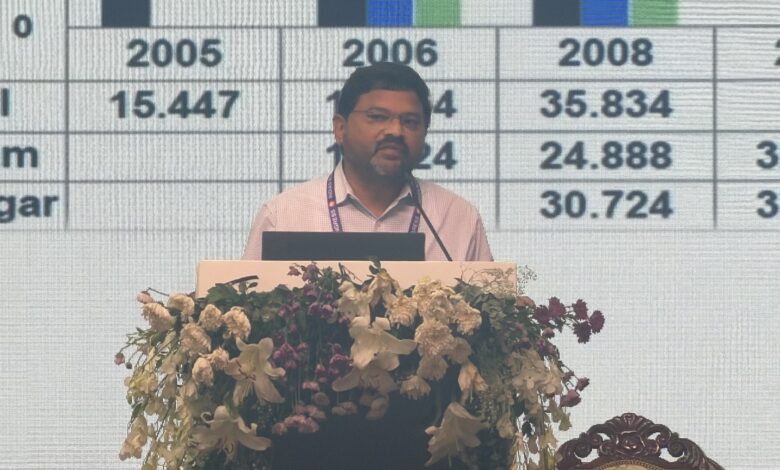
Prof. S. Shankar of the Transportation Engineering Programme, Department of Civil Engineering, National Institute of Technology (NIT) Warangal, highlighted strategies for strengthening rural road infrastructure through climate-resilient design, preventive maintenance, sustainable materials and digital asset management at the 85th Annual Session of the Indian Roads Congress (IRC), being held at HITEX, Hyderabad.
In his presentation titled “Rural Road Infrastructure in India: Issues, Challenges and Strategies for Sustainable Development”, Prof. Shankar emphasised that rural road development must move beyond expanding connectivity to ensuring all-weather accessibility, durability and long-term value from public investment.
Referring to progress under the Pradhan Mantri Gram Sadak Yojana (PMGSY), he cited approximately 7.97 lakh km of completed rural roads, connecting 1,62,876 habitations, along with 10,833 completed bridges, as reported in July 2026. Eligible habitation connectivity had also exceeded 99.6 per cent, according to figures reported in early 2026.


The presentation identified inadequate planning, poor drainage, weak subgrades, pavement failures, construction quality deficiencies and insufficient maintenance funding as major challenges. Climate-related risks such as floods, landslides, extreme rainfall and high temperatures were also highlighted.
Prof. Shankar presented comparative data on Low-Volume Road (LVR) construction costs, with and without cross-drainage works, across Warangal, Khammam and Karimnagar districts during 2005–2013.
Advocating a lifecycle-based approach, he called for appropriate pavement design, effective drainage, stringent quality control and greater use of locally available sustainable materials. He stressed that preventive maintenance should take priority over repeated repairs and that road projects must be evaluated based on whole-life costs rather than initial construction expenditure.
Digital monitoring, road asset management systems and performance-based maintenance were identified as essential tools for improving road performance and managing rural networks throughout their service life.
He concluded that climate-resilient design, technology-driven planning and sustainable maintenance are vital to developing durable rural roads, strengthening connectivity and supporting India’s economic development.