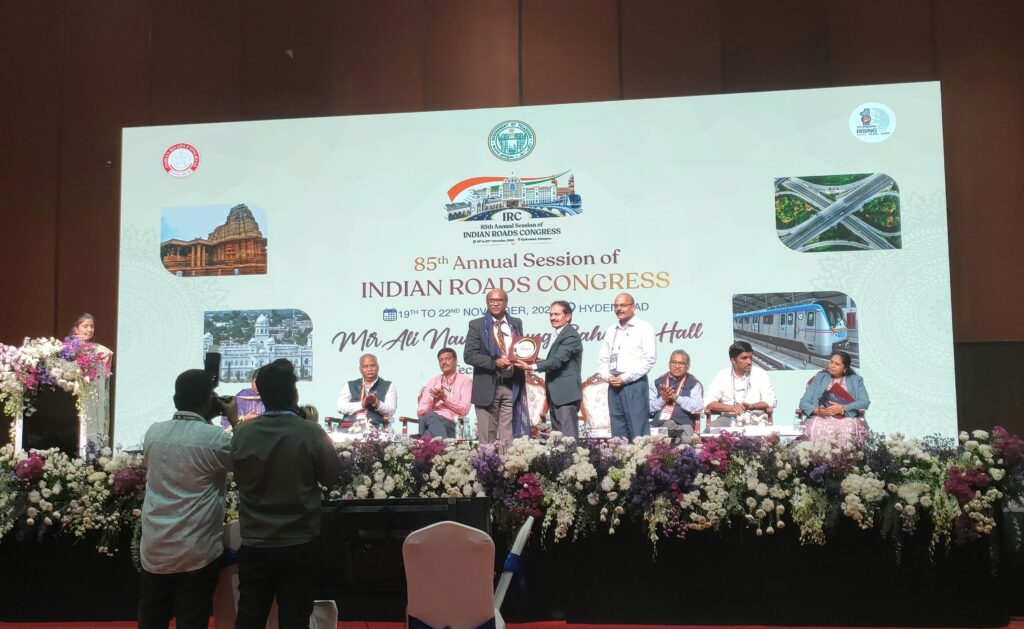
The 13th technical session of the 85th Indian Roads Congress (IRC), featuring research and technological initiatives led by CSIR–Central Road Research Institute (CSIR-CRRI), focused on advancing India’s highway infrastructure through artificial intelligence, sustainable construction materials and digital technologies.
Drawing on a joint road research report prepared by IRC and CSIR-CRRI, the session examined innovations in road research databases, eco-friendly materials, bridge engineering, road safety, AI-based contract management and digital planning.
Digital platform to create national road research database


CSIR-CRRI has developed a cloud-based digital portal to streamline the collection and publication of road research data and avoid delays in annual research reports. Educational institutions, construction companies and contractors can upload project details, research papers and theses within five to 10 minutes.
More than 100 pilot projects have already been uploaded, with a target of collecting one to two lakh research records annually in the future. The platform also uses AI-based Large Language Models (LLMs) to analyse research material and automatically generate presentations and PDF reports.
Bio-binders and recycled materials for sustainable roads
With India importing approximately 40 per cent of its bitumen requirements, researchers are exploring bio-binders derived from agricultural waste as an alternative construction material. Bio-oil can potentially replace 20–30 per cent of bitumen in suitable applications. A commercial production plant has reportedly commenced operations in Puducherry.
Experiments using Recycled Asphalt Pavement (RAP) have demonstrated the potential to incorporate 35–45 per cent recycled material in road construction. Steel slag is also being explored as an alternative to conventional aggregates.
More than 6,000 km of Full Depth Reclamation (FDR) works have been undertaken in Andhra Pradesh, according to the session presentation.
The proposed revision of IRC:37 guidelines is expected to introduce a mechanistic-empirical pavement design approach, enabling more accurate assessment of pavement durability, cracking and deformation.
AI-based contract management and bridge monitoring
The session highlighted the growing challenge of contract-related disputes in infrastructure projects, with the value of pending arbitration cases reportedly reaching around ₹1 lakh crore across the country.
A study drawing on inputs from 225 clients, contractors and consultants analysed 49 risk factors. It identified procedural shortcomings during contract implementation, rather than contract provisions alone, as major contributors to disputes. An AI-based early-warning system was proposed to identify potential risks and help prevent disputes.
In bridge engineering, specialised approach slabs have been developed to address settlement near bridge approaches. Landslide-prone locations in Himachal Pradesh have also been identified, while geotextile technology has been used in roads under the Pradhan Mantri Gram Sadak Yojana (PMGSY).
Monitoring of the Signature Bridge reportedly showed that more than 90 per cent of sensor readings matched design predictions. The session emphasised the need for continuous structural health monitoring to improve bridge safety and maintenance.
Urban freight and road safety measures
To improve urban freight movement, 11 interventions were proposed, including ring roads, freight consolidation centres and electric freight corridors.
Citing a Ministry of Road Transport and Highways (MoRTH) study, the session referred to recommended speed limits of 80 kmph on multilane expressways and 35–50 kmph on major urban roads.
A road safety audit of Amaravati recommended replacing raised vertical kerbs with mountable kerbs to allow vehicles to cross them more easily where required. The session also highlighted the absence of a full-scale crash barrier testing facility in India, resulting in dependence on overseas certification.
Digital platform for integrated road planning
Researchers from Tamil Nadu presented a Python-based web platform integrating road alignment, terrain analysis, identification of water crossings, pavement design and cost estimation.
In one application involving an 80.88-km road alignment, the platform identified 81 water-crossing locations and estimated earthwork quantities, including excavation and embankment, within minutes.
Four priorities for future road development
Session Chairperson Dr. Chalamuri Ramachandra and Co-Chairperson Dr. P. Langa outlined four major priorities: incorporating research on bio-binders and steel slag into IRC standards; adopting AI-based contract management systems; promoting continuous bridge monitoring; and expanding the national road research portal to Public Works Departments across all States.
The deliberations underscored the importance of integrating research, artificial intelligence, sustainable construction materials and digital planning to make India’s road infrastructure safer, more durable, cost-effective and environmentally sustainable.