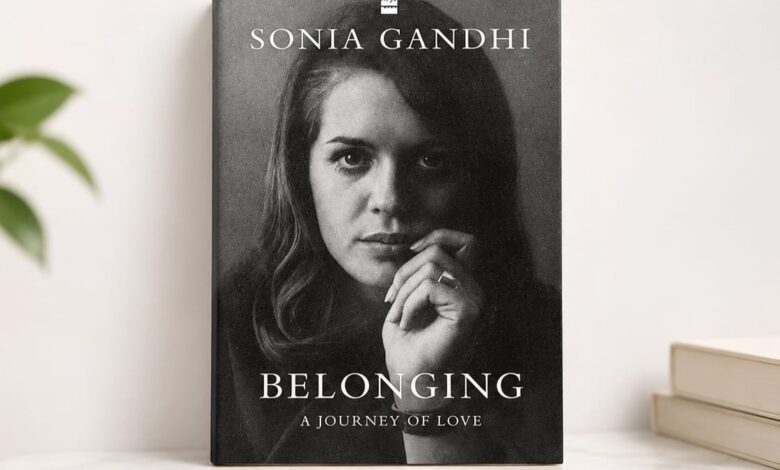
Congress Parliamentary Party Chairperson Sonia Gandhi’s 544-page memoir, Belonging: A Journey of Love, released in India on November 10, has triggered a political debate, with leaders across party lines offering contrasting views on her recollections of the 2004 Prime Ministerial decision, the Emergency, Operation Blue Star and her interactions with senior political figures.
Published in India by HarperCollins India and internationally by Alfred A. Knopf, the book traces Gandhi’s journey from her childhood in Italy to her life in the Nehru-Gandhi family and her eventual entry into Indian politics. She has described it as a personal account shaped by love, loss, family relationships and experiences in public life.
Recounts decision to decline Prime Minister’s post

One of the most discussed sections concerns her decision not to become Prime Minister after the Congress-led United Progressive Alliance (UPA) won the 2004 Lok Sabha elections.
Gandhi writes that she had discussed the possibility with her children, Rahul Gandhi and Priyanka Gandhi Vadra, months before the elections. According to her account, both opposed the idea, fearing that she could meet a fate similar to that of her mother-in-law, Indira Gandhi, and husband, Rajiv Gandhi, who were assassinated.
After the election results, alliance leaders pressed her to accept the post. She recalls briefly yielding to the pressure, saying “Theek hai”, but later reaffirmed her decision after further reflection and discussions with her children.
She subsequently proposed Manmohan Singh for the post, describing him as a leader with integrity, administrative experience and the ability to lead the government.
Pranab Mukherjee’s reported ambition
The memoir also recalls a conversation with former President Pranab Mukherjee around 2010. Gandhi writes that Mukherjee suggested it might be time for a change at the top, a remark she interpreted as a possible indication of his interest in becoming Prime Minister.
Mukherjee’s daughter, Sharmistha Mukherjee, responded on X, questioning why her father’s ambition should have come as a surprise. She said aspiring to the top political office was natural for an experienced leader who had risen through merit and hard work. She also maintained that her father had not harboured resentment against Sonia Gandhi and understood the human insecurities involved.
BJP leaders accuse memoir of ‘whitewashing’
The memoir drew criticism from BJP leaders, particularly over its treatment of the Emergency, Operation Blue Star and the 1984 anti-Sikh violence.
BJP national spokesperson C.R. Kesavan suggested that the book should have been titled Whitewashing rather than Belonging. He accused Gandhi of presenting a softened account of the Congress party’s historical record and questioned its treatment of major events involving the Nehru-Gandhi family.
BJP leader Tarun Chugh also questioned the memoir’s references to the Emergency, Operation Blue Star and the 1984 violence, arguing that these episodes required accountability.
Suheldev Bharatiya Samaj Party leader and Uttar Pradesh minister Om Prakash Rajbhar, an NDA ally, criticised the memoir and disputed the account that Rahul and Priyanka Gandhi had opposed their mother becoming Prime Minister primarily because of the assassinations in the family. He also questioned its references to the Babri Masjid demolition.
AAP questions historical recollections
AAP Delhi president Saurabh Bharadwaj questioned Gandhi’s account of Indira Gandhi’s reaction to the damage caused during Operation Blue Star. He described the recollection as hearsay that could not be independently verified.
Bharadwaj also argued that expressions of remorse over the 1984 anti-Sikh violence should be accompanied by proper investigations and accountability.
Reactions from other political leaders
Samajwadi Party MP Mohibullah Nadvi defended the personal dimension of Gandhi’s story, referring to the loss of her mother-in-law and husband and her decision to continue living in India and remain engaged in public life. He said her experiences should not be viewed exclusively through a political lens.
JD(U) MP Sanjay Kumar Jha questioned Gandhi’s account of the 2004 decision, referring to reports that Samajwadi Party leader Mulayam Singh Yadav had been unwilling to support her candidature for Prime Minister.
Congress leaders welcome the memoir
Congress leaders welcomed the publication and highlighted its personal narrative and Gandhi’s political journey.
Rahul Gandhi congratulated his mother in a post on X, writing: “Sixty years in public life, and still the same person. Proud of you, Ma.”
Priyanka Gandhi Vadra drew attention to her mother’s interview with The Hindu, which discussed personal memories, political decisions and Indian democracy.
Congress MP Shashi Tharoor congratulated Sonia Gandhi on the publication, describing the book as a journey of love, loss and resilience. Party general secretary K.C. Venugopal praised her leadership of the Congress and the UPA, while spokesperson Pawan Khera described the memoir as an expression of the “Politics of Love”.
In her own post on X, Sonia Gandhi shared an excerpt from the chapter on declining the Prime Minister’s post, including the line: “Sonia, be true to yourself.” She reiterated that the memoir was a personal book rather than primarily a political account.
Revisits key episodes in political history
Beyond the 2004 decision, the memoir revisits major events in the Nehru-Gandhi family’s history, including the Emergency imposed in 1975, Operation Blue Star, the assassination of Rajiv Gandhi and the demolition of the Babri Masjid in 1992. Gandhi describes the Emergency as a mistake and recalls watching the Babri Masjid demolition on television.
She also writes about family relationships, differences with Maneka Gandhi, the loss of her first child and her limited personal interactions with Prime Minister Narendra Modi, characterising their differences as primarily ideological.
The memoir has brought renewed attention to the intersection of personal recollection and political accountability. While Congress leaders have emphasised its human dimension, critics from the BJP, AAP and NDA have challenged aspects of its historical narrative and questioned the explanations offered for key political decisions.