Restoration targeted before 2027 monsoon; rehabilitation works expected to begin by December-end
Hyderabad: Telangana Irrigation and CAD Minister N. Uttam Kumar Reddy on Saturday accused the previous BRS government of misleading farmers over the Kaleshwaram project, saying the rehabilitation of the Medigadda, Annaram and Sundilla barrages was being undertaken in accordance with the findings of the National Dam Safety Authority (NDSA) and recommendations of technical experts.
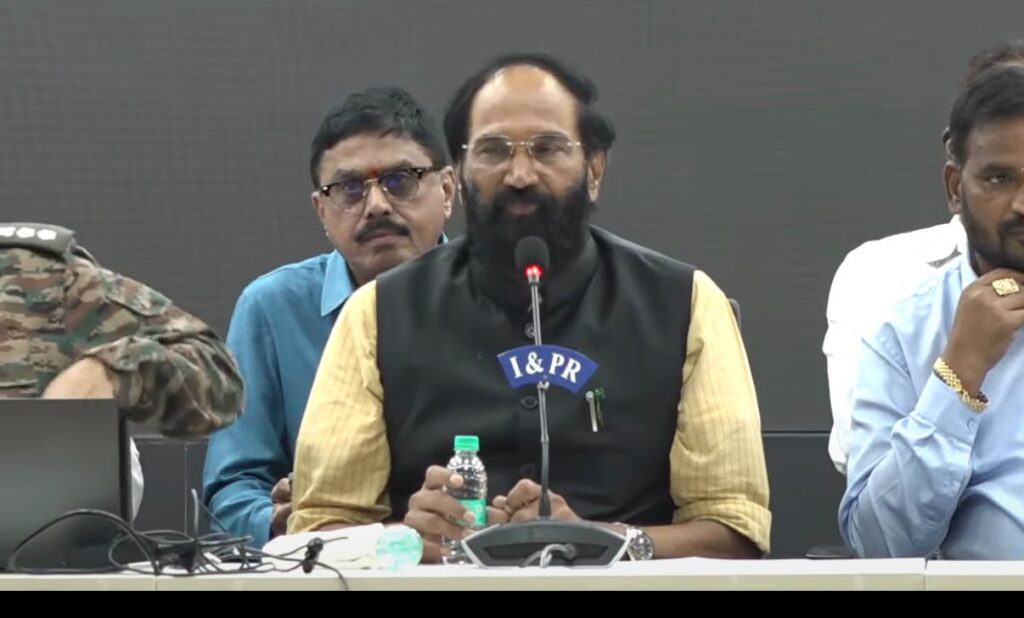
Addressing a press conference at the Secretariat, the minister said the government was committed to restoring the three barrages through a comprehensive, evidence-based process, with rehabilitation works targeted to begin by the end of December 2026 and restoration aimed before the 2027 monsoon, subject to technical approvals and implementation requirements.
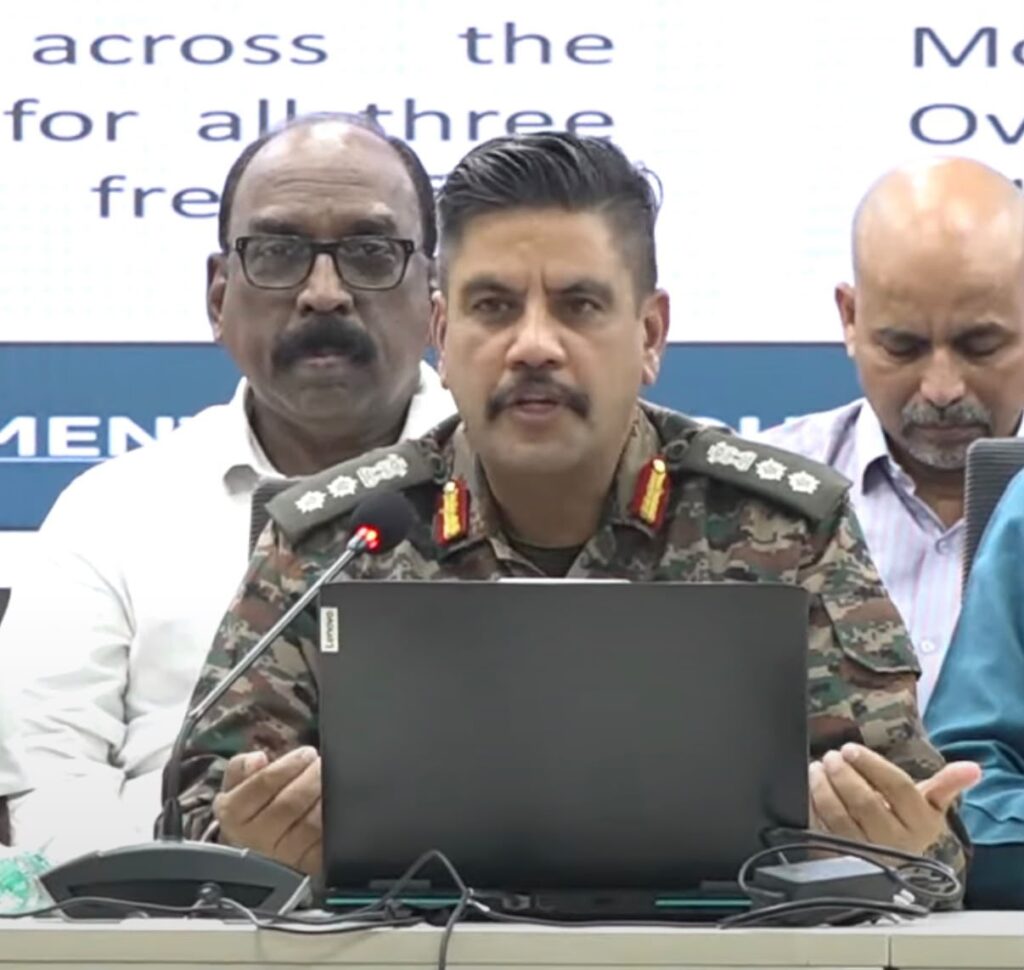
Parikshit Mehra, an Indian Army engineering officer deputed to the Telangana government for rehabilitation-related work, presented the chronology of the Medigadda incident, the deficiencies identified in all three barrages and the proposed engineering interventions. Minister G. Vivek Venkataswamy also criticised the previous administration, alleging that its project decisions had resulted in substantial public expenditure without delivering the expected long-term benefits.


NDSA investigation identifies deficiencies
The critical incident at the Medigadda (Laxmi) barrage occurred on October 21, 2023, when Pier 20 and adjacent Piers 18, 19 and 21 in Block 7 experienced settlement. According to the technical presentation, the pond level at the time was EL +98.00 metres, with approximately 10.33 TMC of water. The water was subsequently depleted to prevent further damage.
The NDSA constituted a six-member committee on October 22, 2023, to inspect the barrage, determine the causes of the failure and recommend remedial measures. The committee inspected the structure on October 24 and communicated its interim findings on November 1, 2023.
The interim findings attributed the incident to lapses in construction, planning and management, according to the presentation. The NDSA submitted its final report on April 24, 2025, identifying deficiencies across the project lifecycle and recommending comprehensive rehabilitation.
Mehra said the final report identified similar fundamental deficiencies in the Annaram (Saraswathi) and Sundilla (Parvathi) barrages, which were built using the same basic design approach as Medigadda.
The NDSA directed that all three structures be maintained under free-flow conditions, with impoundment prohibited pending rehabilitation and the necessary technical clearances. The presentation stated that the barrages were not fit for water storage or diversion in their existing condition.
Foundation weaknesses and seepage concerns
The technical presentation identified deficiencies in secant pile cutoff walls as a major concern in the failure of the barrage foundation. These walls are designed to restrict seepage beneath a structure and prevent flowing water from carrying soil particles away from the foundation.
According to the findings presented, inadequate quality-control procedures had affected the assessment of the watertightness and integrity of the piles and their joints. Holes and porous sections in the cutoff walls reportedly provided pathways for water to pass beneath the foundation.
At Medigadda, defects were identified around Piers 20 and 21 on the upstream side and Pier 17 downstream. The presentation attributed the subsequent piping, formation of underground cavities and settlement of Block 7 to seepage through these defects.
Piping occurs when flowing water progressively carries soil particles away from beneath a structure, creating voids and weakening its foundation. The loss of supporting material can cause the foundation raft to settle, leading to cracks, pier movement and damage to the superstructure.
The presentation also cited deficiencies associated with alternating reinforced cement concrete (RCC) and plain cement concrete (PCC) piles. Construction-related problems reportedly created recurring leakage paths at Annaram and Sundilla, where some unreinforced piles were said to lack proper contact with the raft.
Other concerns included damage to downstream concrete blocks and launching aprons after the first monsoon, without timely restoration, and extensive deterioration of the approximately 200-mm-thick M30 wearing coat over the rafts in several bays.
The technical assessment indicated that the deterioration of downstream protection and exposure of structural concrete had contributed to the progression of damage.
Hydraulic design and flood assessment questioned
The NDSA findings, as outlined in the presentation, also raised concerns about hydraulic design, hydrological assessments and physical model studies.
Gauge-discharge curves at the barrage sites were reportedly developed using assumptions, including Manning’s equation, without adequate field validation. The presentation said this affected the reliability of hydraulic calculations and tailwater rating curves.
At Sundilla, the design flood was taken as 57,000 cubic metres per second, against the Central Water Commission’s approved figure of 64,937 cubic metres per second. According to the presentation, the lower design value contributed to inadequacies in the spillway design.
The assessment also raised concerns about the calculation of scour and cutoff depths under realistic operating conditions, including situations in which one or a limited number of gates remained partially open while maintaining the pond level.
Mehra said the stilling basins and end sills had not been adequately designed for certain gate-opening conditions and the possible sweep-out of the hydraulic jump. These deficiencies could result in high-velocity flows, downstream erosion and damage to protective concrete.
Physical model studies conducted by TSERL were also criticised for not adequately examining critical operating scenarios, particularly the opening of a single gate while maintaining the pond level. The presentation said this limited the identification of potential deficiencies in energy dissipation and gate-seat configurations.
The combined effects of porous cutoff walls, unsafe exit gradients and piping were cited as contributing to the formation of cavities beneath the Medigadda foundation. The resulting settlement and cracking affected the Block 7 raft and piers, while several piers tilted and gantry girders became distorted, rendering the barrage and bridge non-functional.
The presentation also referred to 2020 satellite imagery and reports of sand boils as possible indications that progressive piping and loss of silt had begun earlier. It alleged that these warning signs were not adequately reported or addressed.
At Annaram and Sundilla, recurring downstream water jets, sand boils and damage to plinth slabs, concrete blocks and wearing coats were attributed to similar foundation and construction deficiencies, compounded by inadequate operation and maintenance.
The six broad areas of concern identified in the presentation were inadequate geotechnical investigations; deficiencies in hydraulic and structural design; defects in secant pile cutoff systems; shortcomings in construction and quality control; foundation failure caused by piping; and inadequate operation, maintenance and dam safety practices.
The presentation also cited the absence of an operation and maintenance manual, inadequate pre- and post-monsoon inspections, and distress signals dating back to 2019 that allegedly went unaddressed.
Barrages to remain under free-flow conditions
The NDSA’s directions require all three barrages to remain under free-flow conditions until rehabilitation and the necessary technical clearances are completed.
According to the references cited in the presentation, Block 7 at Medigadda is non-functional, and the barrage cannot be used for water diversion. The relevant reference in the NDSA report is page 346.
Annaram is being maintained under free-flow conditions and is considered unsafe for water diversion, with the presentation referring to pages 351–352 of the report. Sundilla is similarly being maintained under free-flow conditions and is considered unsafe for diversion, with references to pages 355–356.
Uttam Kumar Reddy said the government could not disregard the safety authority’s directions merely to counter criticism over the non-operation of the pumping system. He emphasised that the three barrages were interdependent components of the planned water-lifting arrangement and could not simply be operated independently while their safety remained unresolved.
The minister said pumping operations would resume only after the required rehabilitation and technical approvals.
CWPRS, AFRY India and IIT Bombay engaged
The government has engaged the Central Water and Power Research Station (CWPRS) to undertake detailed investigations, testing and health assessments of the structures. AFRY India, in association with IIT Bombay, has been entrusted with rehabilitation design work.
A coordination committee comprising the CWPRS director, the design consultant, the Chief Engineer of the Central Design Organisation, the SDSO and Irrigation and CAD officials has also been constituted to coordinate investigations and rehabilitation in accordance with the NDSA’s recommendations.
The health assessment has included additional and deeper boreholes, ground-penetrating radar (GPR) surveys, non-destructive testing of concrete and gates, and laboratory testing of soil samples.
Mehra said the investigations were intended to identify voids beneath the foundation rafts, assess ground conditions and determine the measures required to improve the foundations, strengthen seepage cutoffs and correct deficiencies in energy-dissipation arrangements.
Technical oversight committee scrutinises designs
The Union Ministry of Jal Shakti constituted a Technical Oversight Committee (TOC) on June 30, 2026, to scrutinise the rehabilitation process. The presentation said the committee was constituted at the insistence of the Telangana Irrigation and CAD Minister.
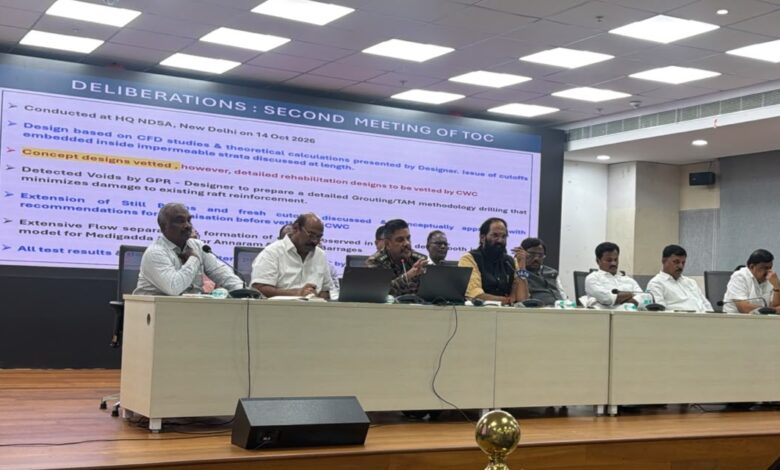
The committee includes representatives of the NDSA and the Central Water Commission (CWC). It held meetings on July 31 and October 14, 2026, at the NDSA headquarters in New Delhi.
At the second meeting, the design consultant presented proposals based on computational fluid dynamics (CFD) studies and theoretical calculations. Discussions covered cutoff walls extending into relatively impermeable strata, extensions to stilling basins and additional cutoff systems.
The committee also reviewed voids identified through GPR surveys and discussed the need for a detailed grouting and tube-a-manchette (TAM) methodology. The drilling procedure is to be designed to minimise damage to existing reinforcement within the foundation rafts.
The presentation reported extensive flow separation and eddy formation in CFD studies and two-dimensional model studies of Medigadda, as well as CFD studies of Annaram and Sundilla.
The proposed extensions to the stilling basins and installation of new cutoff systems were conceptually accepted, subject to optimisation and detailed scrutiny by the CWC. The detailed rehabilitation designs are to undergo further technical examination before implementation.
Stilling basins to be extended
A stilling basin reduces the energy of water released through barrage gates before it enters the downstream river. If it is too short or inadequately designed, high-velocity water can escape the intended energy-dissipation zone, erode the riverbed and aggravate scouring around the foundation.
The proposed rehabilitation measures include extending and strengthening stilling basins, installing new cutoff systems and improving foundations wherever investigations reveal voids or weak material. The design team is also examining the appropriate depths of cutoff walls and the ability of the structures to withstand the hydraulic conditions expected during operation.
At Medigadda, the existing stilling basin length was stated to be 46 metres, with a further 66 metres proposed. Similar deficiencies were identified at Annaram and Sundilla.
The additional structural work would also require extensions to certain piers to address uplift forces and maintain stability.
For the damaged Block 7 at Medigadda, alternative rehabilitation approaches are being evaluated. The decision on whether to dismantle and reconstruct the block or adopt another engineering solution will be based on specialist recommendations and technical scrutiny.
Uttam Kumar Reddy said the government would not take such decisions on political considerations.
Work commencement targeted by December-end
The presentation outlined a schedule aimed at completing rehabilitation before the 2027 monsoon. The conceptual design stage was marked as achieved by the end of September 2026, while approximate costing and government approvals were scheduled for completion by the end of October.
Mobilisation of agencies was targeted by the end of November, followed by commencement of rehabilitation works on all fronts by the end of December 2026. Completion is targeted before the 2027 monsoon.
The government is also seeking to optimise the designs and contain expenditure without compromising structural safety. The proposed works will undergo further technical scrutiny before implementation.
The timeline remains subject to detailed design finalisation, statutory and technical approvals, and execution requirements.
Uttam Kumar Reddy targets BRS over project decisions
Uttam Kumar Reddy alleged that the decision to shift the original Pranahita-Chevella project to Medigadda had increased expenditure and exposed Telangana to avoidable engineering and financial risks.
He claimed that the original project was envisaged at an estimated cost of ₹38,000 crore to provide irrigation to approximately 16 lakh acres. He argued that completing the original scheme, alongside other irrigation projects, could have delivered irrigation benefits more economically.
The minister accused the previous administration of prioritising commissions over sound engineering and financial prudence. He also alleged that the expenditure associated with Kaleshwaram had imposed a substantial burden on the State and future generations.
Linking the project’s problems to the challenges faced by farmers during prevailing dry conditions, he argued that better irrigation planning could have improved Telangana’s resilience to rainfall deficits.
The minister further claimed that the State had recorded its highest-ever paddy production and procurement during the Congress government’s tenure, despite the three barrages remaining unavailable for their intended water-storage and diversion functions. He said official Irrigation Department records would demonstrate increased utilisation of Krishna and Godavari waters under the present administration compared with the previous government.
These claims and comparisons were made by the minister and require assessment against official expenditure, agricultural and water-utilisation records.
Vivek Venkataswamy also criticised the previous BRS government, alleging that its decisions on project design and construction had resulted in substantial expenditure without securing the expected long-term benefits. He argued that completing earlier irrigation plans could have reduced the State’s vulnerability to drought conditions.
Both ministers said the rehabilitation process would be guided by statutory institutions, technical investigations and expert recommendations. Uttam Kumar Reddy said responsibility for the barrage failures would have to be examined in light of the findings and the accountability of the agencies involved in design, construction and maintenance.
The government reiterated that its immediate priorities were to complete the investigations, secure the necessary design approvals, mobilise agencies and execute comprehensive rehabilitation works, with the objective of restoring the three barrages to safe operation before the 2027 monsoon.